

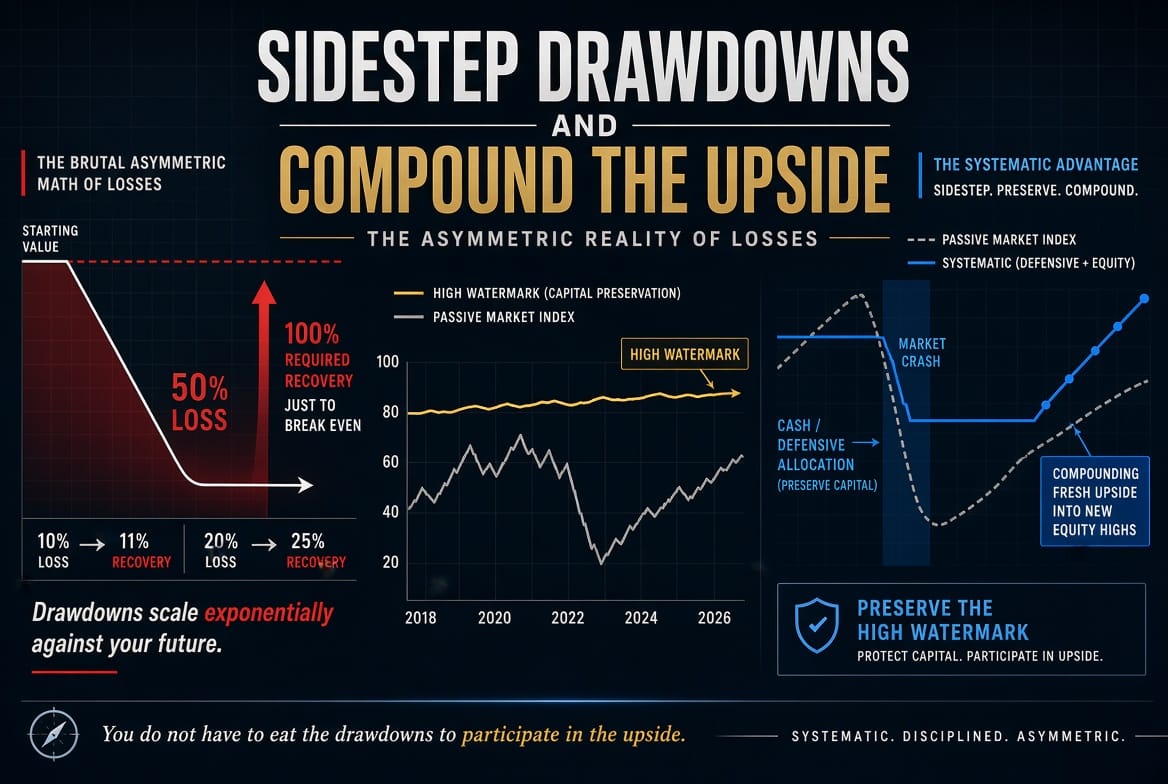
The financial industry spends a massive amount of time talking about compounding gains, but it spends almost no time educating investors on the most destructive force in finance: the asymmetric math of a drawdown.
Drawdowns do not scale linearly; they scale exponentially against your future returns. If you take a 10% loss, you need an 11.1% gain to get back to even. That is manageable. If you take a 20% loss, you need a 25% gain to recover.
But if you hold a passive portfolio through a structural bear market and take a 50% loss, you do not need a 50% gain to recover. You need a 100% gain just to repair the damage and return to your starting principal. For a well-capitalized investor with significant assets, taking a 50% drawdown means watching half of your net worth vanish, followed by spending the next five to seven years taking aggressive market risks just to claw back to zero. Years of hard-earned wealth and time, completely wiped out.
The Recklessness of Buy and Hold
This is exactly why “buy and hold” is an incredibly reckless methodology for anyone who has already accumulated a substantial asset base. The primary objective of professional trend following is not to capture every single tick of a roaring bull market. The objective is to ruthlessly cut losers and step aside during market crashes, thereby preventing the catastrophic drawdowns that destroy the math of compounding.
We achieve this by respecting the trend and the tail. When structural momentum breaks across our longer-duration timeframes, we exit. We do not average down into losing positions, catching falling knives in the hope of a miraculous rebound. We recognize that capital preservation is the absolute prerequisite for long-term growth.
Preserving the High Watermark
By actively managing risk and sidestepping those deep left-tail drawdowns, you preserve your capital base at its highest watermark. The psychological and financial benefits of this approach are massive.
When the market inevitably bottoms and enters a new quantitative uptrend, your money is immediately compounding fresh, new upside. You are hitting new equity highs while the buy-and-hold crowd is still desperately trying to dig themselves out of a hole. You do not have to eat the drawdowns to participate in the upside; you just need a system disciplined enough to know when to walk away.



Discussion
Thoughtful questions and respectful disagreement are welcome.