
The entire financial media ecosystem is built on the allure of the prediction. Every morning, millions of investors tune into financial television to watch a parade of economists, fund managers, and strategists confidently forecast where the S&P 500 will end the year, what the Federal Reserve will do with interest rates at the next meeting, and how the latest CPI or PCE data will impact bond yields. We are culturally conditioned to believe that making money in the markets requires a crystal ball. We assume that if we can just build a complex enough macroeconomic model, we can anticipate the future and position our portfolios ahead of the crowd.
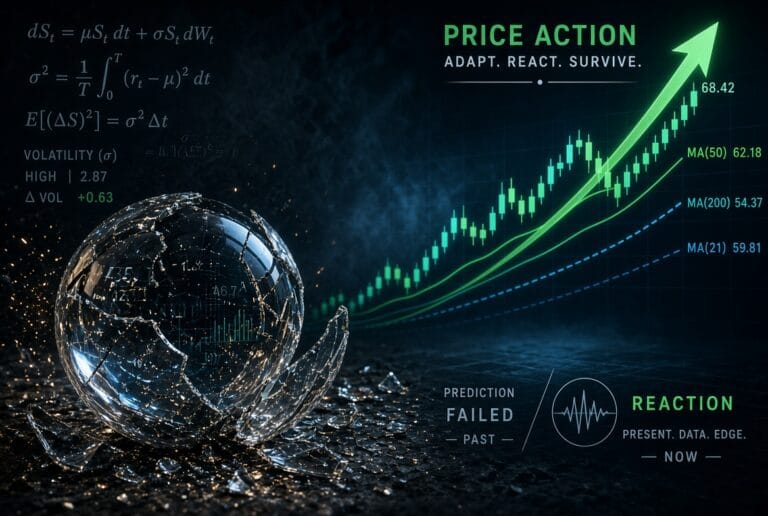
The reality of financial markets is far less romantic. Markets are complex, non-linear, dynamic systems driven by millions of interacting variables. Trying to predict exactly how a sudden spike in AI capex will fundamentally alter global supply chains, or how shifting geopolitical tensions in the Strait of Hormuz will filter down into domestic inflation metrics, is an exercise in futility. Even if your fundamental macroeconomic thesis is entirely correct, the market’s reaction to that data can be wildly irrational and delayed by months. To predict is to gamble on variables you fundamentally cannot control.
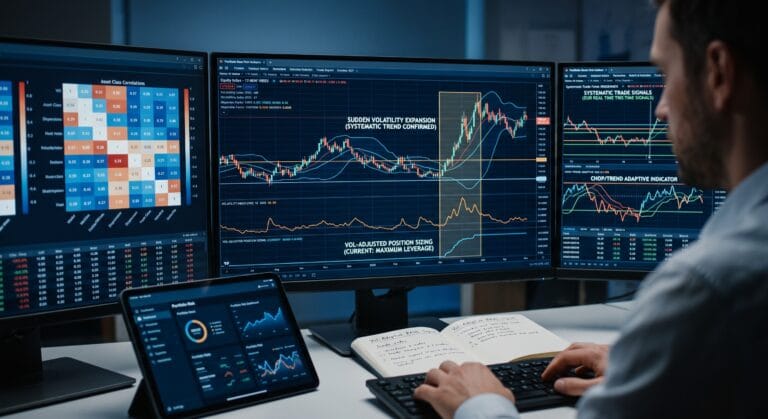
Systematic trend following completely rejects the premise of forecasting. The systematic trader does not care what the macroeconomic data should do to the market; they only care what the market is actually doing in response to the data. By shifting the mandate from predicting to reacting, the trend follower lifts an immense psychological burden. You no longer have to outsmart the economists or untangle complex global narratives. You simply wait for the aggregate market to process the information, establish a definitive directional vector, and then you react by aligning your capital with that established momentum. It is a philosophy of profound humility, accepting that the tape is always smarter than the individual.
The Self-Fulfilling Prophecy: How Herd Behavior Sustains Trends
For a reactive strategy to be profitable, there must be a structural reason why price movements continue long enough to capture meaningful gains. If markets were perfectly efficient, reacting would be useless because the price would instantaneously adjust to new information. However, markets are not perfectly efficient. They are driven by human emotion, structural frictions, and massive institutional flows that take time to fully execute.
Once a trend is mathematically established—perhaps by price breaking through a long-term moving average or exceeding a specific volatility threshold—a powerful self-fulfilling prophecy begins to take shape. Massive quantitative funds, Commodity Trading Advisors (CTAs), and systematic allocators operate on highly correlated algorithmic signals. When the price breaches these critical levels, billions of dollars of institutional capital are mechanically triggered to enter the market. This forced buying or selling creates tremendous momentum, which in turn triggers the next layer of trend-following algorithms and forces options dealers to hedge their gamma exposure, adding even more directional fuel to the fire.
As a systematic retail or independent trader, you do not need to predict when this institutional stampede is going to happen. You just need a mathematical system that alerts you when the stampede has officially begun. By reacting to the structural footprint of this capital, you are effectively surfing a wave generated by the largest participants in the market. The trend sustains itself not because the fundamental news keeps getting better, but because the mechanical plumbing of the market forces participants to chase the momentum. Reacting to this herd behavior is infinitely more reliable than trying to anticipate what will cause it.
Overconfidence Bias: Why We Think We Can Call Market Tops
The transition from a predictive mindset to a reactive mindset is incredibly difficult for most discretionary traders because it directly assaults the ego. Human beings suffer deeply from overconfidence bias. We want to be the smartest person in the room. There is an immense psychological thrill associated with calling the exact top of a massive bull market or catching the falling knife at the absolute bottom of a crash. When a discretionary trader successfully predicts a turning point, they feel a sense of intellectual superiority.
This ego-driven pursuit is the primary destroyer of retail capital. When the market is in a sustained Goldilocks regime—characterized by accelerating growth and slowing inflation—equities will often push to valuations that fundamental analysts deem “irrational.” The discretionary trader, burdened by their overconfidence, will attempt to short the market, convinced that a reversion to the mean is imminent. They will continue to average down as the market climbs higher, stubbornly fighting the tape because their ego refuses to admit their prediction was wrong. They forget the age-old market adage: the market can remain irrational much longer than you can remain solvent.
A reactive, systematic trend follower surrenders this ego entirely. They do not care if the P/E ratio of the Nasdaq seems absurdly high, or if the nominal GDP data looks disconnected from reality. If the mathematical signals indicate that the trend is up, they remain long. They are perfectly comfortable buying high and selling higher. They have no interest in being the hero who perfectly times the crash. By eliminating the need to be “right” about the macroeconomic future, the trend follower insulates their portfolio from the catastrophic losses born of overconfidence and stubbornness.
The Consistency Factor: Systematic Execution vs. Discretionary Whims
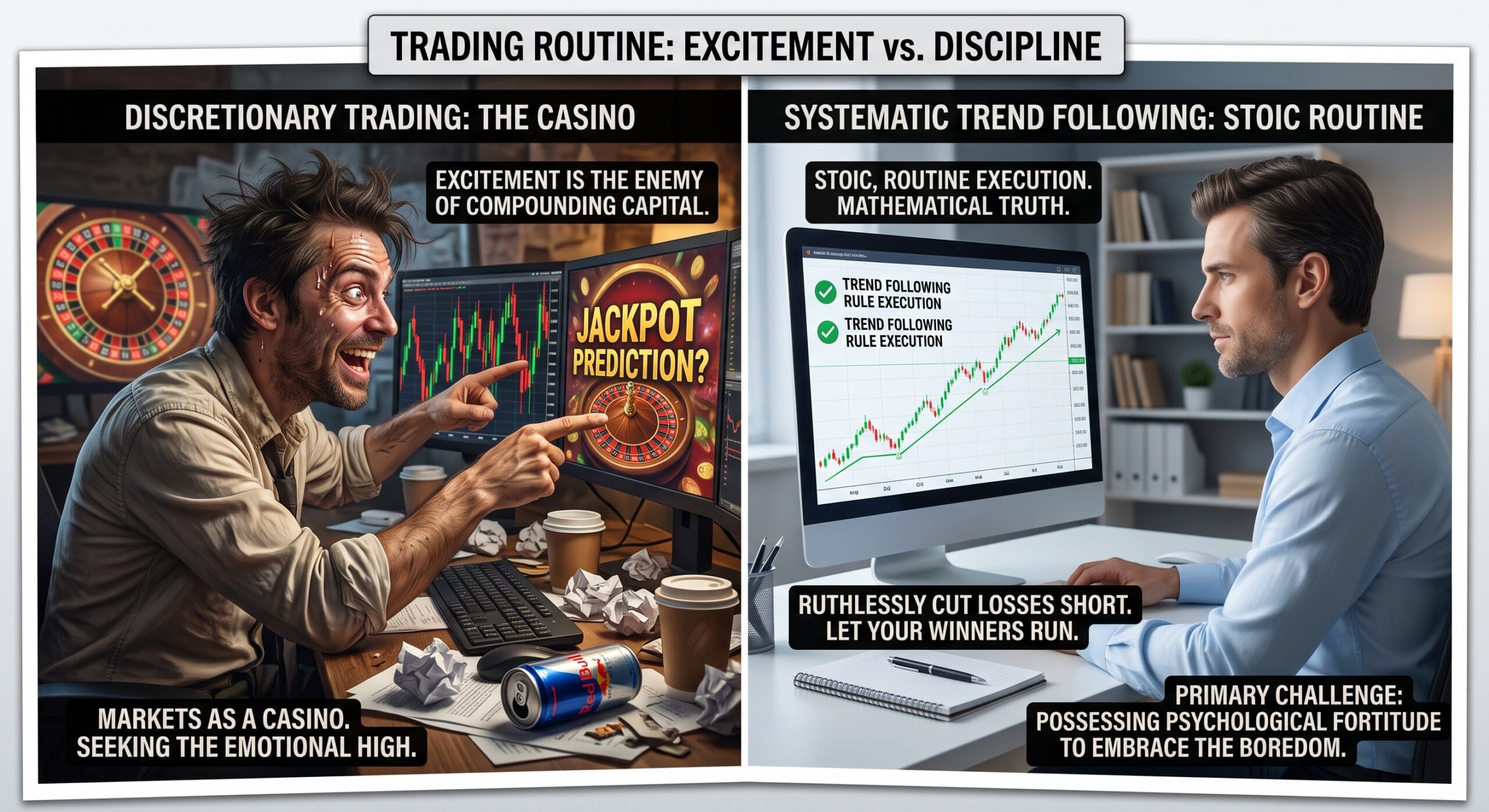
It is important to distinguish between systematic reacting and discretionary chasing. Many amateur traders claim they are “reacting to price action,” but in reality, they are simply suffering from Fear Of Missing Out (FOMO). They watch a stock surge 10% in a single day, feel the emotional pain of being left behind, and impulsively hit the buy button at the very top of a short-term exhaustion move. That is not trend following; that is emotional capitulation.
True systematic reaction requires unbreakable, pre-defined rules. The response to market data must be codified long before the opening bell rings. A professional trend follower measures the market across distinct, mathematical timeframes. They look for alignment. They wait for the short-term Trade momentum, the intermediate-term Trend direction, and the long-term Tail risk indicators to all point in the same direction before deploying capital.
When those specific, quantifiable conditions are met, the reaction is absolute and automatic. There is no debate about whether the setup “feels” right today. There is no pausing to check if a favorite financial guru agrees with the trade on Twitter. The algorithm dictates that the environment is conducive to a trend, and the trader executes the mandate. This consistency is the ultimate edge. By transforming trading from an emotional guessing game into an administrative function, the systematic trader ensures that they are always participating in the highest-probability setups, regardless of how terrifying or illogical the prevailing market narrative might seem.
Capping the Downside: Algorithmic Risk Parameters in Action
The inherent reality of a reactive strategy is that you will frequently react to false signals. Because you are waiting for price to confirm a direction, you are naturally entering the market after a move has already begun. In choppy, trendless markets, this can result in a frustrating series of whipsaws—buying a breakout only to watch it fail, or shorting a breakdown only to watch it instantly reverse. If you stop predicting, you must accept that a significant percentage of your reactions will be statistically “wrong.”
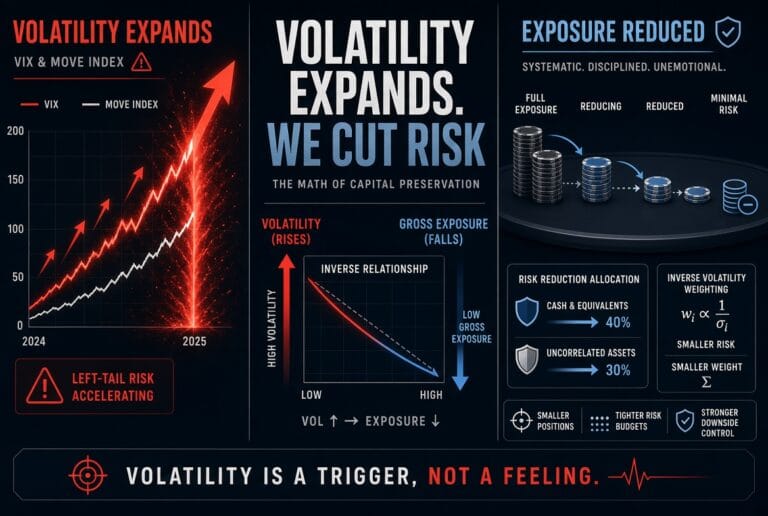
This is precisely why robust trend following is entirely dependent on algorithmic risk management. If you are going to let the market dictate your entries, you must also let mathematics dictate your survival. Professional systematic models heavily utilize volatility metrics to protect the downside. By monitoring the VIX or the MOVE index, the system understands the current speed and danger of the market. When volatility is high, the system reacts by dynamically reducing position sizes, ensuring that the inevitable false breakouts only result in negligible paper cuts.
Furthermore, the reaction to a losing trade is just as systematic as the entry. The moment a hard stop is breached or a trend signal breaks its critical moving average, the position is liquidated. There is no hoping, no praying, and no predicting that the asset will bounce back. The tape has dictated that the trend is broken, and the trader reacts by preserving their capital. By relentlessly cutting these small losses and allowing the massive, regime-driven trends to run their course, the trend follower mathematically guarantees that their portfolio will survive the chop and thrive in the chaos.