

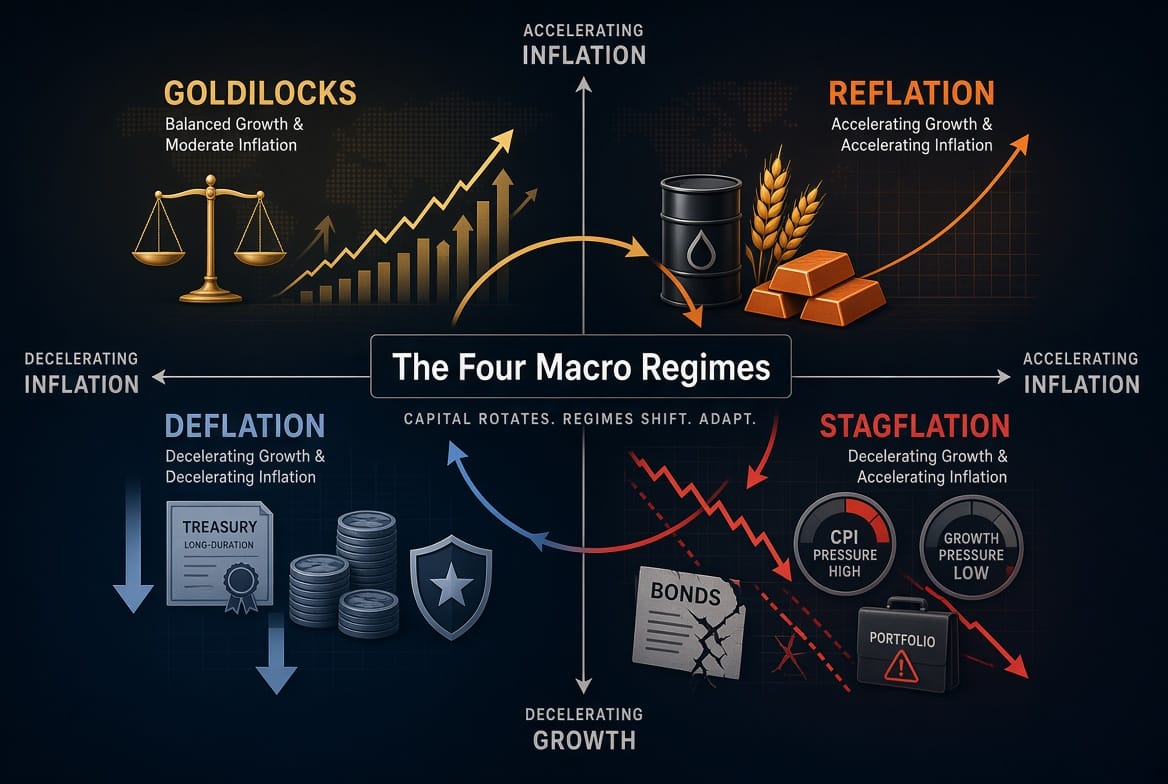
The financial media is built on a fundamental misunderstanding of how markets actually function. They sell the illusion that there is a single, permanent playbook for investing: buy high-quality stocks, hold them forever, and endure the pain when the market inevitably fractures. After three decades of running systematic CTA models, I can tell you unequivocally that the market does not care about your loyalty to a single asset class. It only cares about which of the four macro regimes we are currently operating within.
Economies constantly cycle through distinct environments driven by the acceleration or deceleration of two dominant forces: economic growth and inflation. When you plot these two variables against each other, you map out four distinct macro quadrants.
Mapping the Four Economic Quadrants
The first quadrant is Goldilocks—where growth is accelerating while inflation is slowing. This is the environment where traditional buy-and-hold portfolios look like genius operations. Equities soar, credit spreads tighten, and risk assets broadly compound. But the cycle always turns.
Eventually, we shift into Reflation, where both growth and inflation are accelerating simultaneously. Here, the playbook changes. Commodities catch fire, and while certain equities still perform, the underlying mechanics of the bond market begin to shift as yields rise.
Then comes the environment that destroys amateur portfolios: Stagflation. Growth slows down, but inflation remains stubbornly high or accelerates. Traditional 60/40 portfolios are decimated here because both stocks and bonds sell off together.
Finally, we see Deflation, where both growth and inflation plummet, and capital violently rotates into cash and long-duration Treasuries.
Adapting Capital to the Math
When you hold a static portfolio, you are willfully choosing to be blind to these phase shifts. You are essentially hoping that the global economy remains in a Goldilocks state forever. History proves this is a mathematical impossibility. Systematic trend following survives and thrives because it is entirely regime-agnostic.
We do not predict what the Federal Reserve will do, nor do we guess which regime is coming next based on a gut feeling. We measure the incoming economic data—Nominal GDP, CPI, and employment metrics—and systematically map the transitions.
By identifying the current regime, we dynamically rotate capital into the asset classes statistically engineered to thrive in that specific environment, while ruthlessly cutting exposure to the asset classes that are about to get crushed. If Stagflation is flashing on the models, we are already reallocating into cash, TIPS, and commodities. If Deflation is accelerating, we are riding the structural tailwinds of fixed income. You do not have to eat a 30% drawdown just because the macro environment shifted. You simply have to adapt your positioning to align with the math of the current regime.




Discussion
Thoughtful questions and respectful disagreement are welcome.