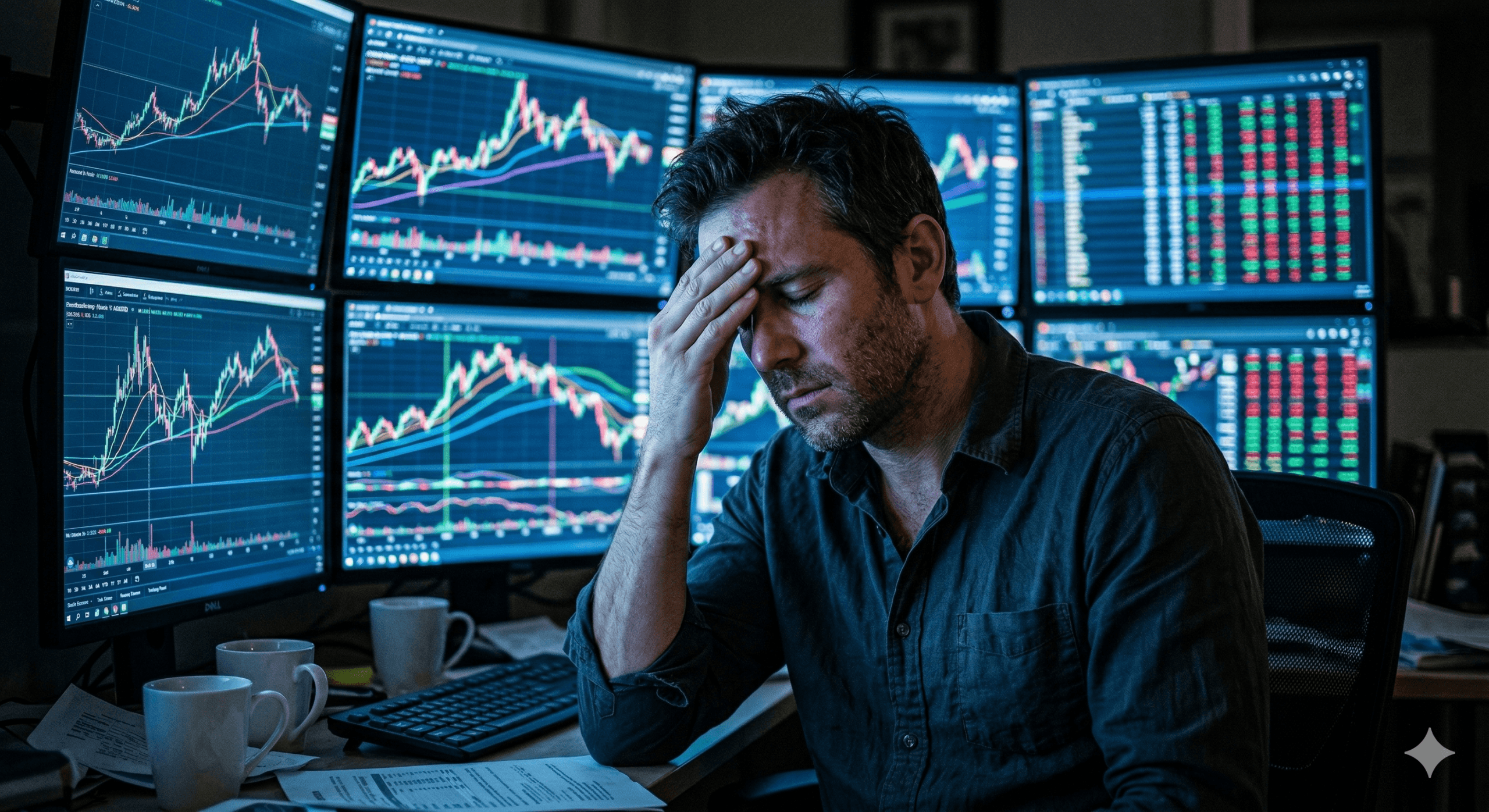
Every discretionary trader knows the feeling. It’s 2:00 PM. You’ve been staring at screens for six hours. Your eyes burn, your third cup of coffee has worn off, and a critical asset class just breached a minor support level. Is it a fake-out? Is it the start of a new regime? Should you sell? Hedge? Average down?
This is the daily crisis of decision fatigue, and it is the silent killer of discretionary trading accounts.
Discretionary trading forces you to make a high-stakes financial choice every single time you look at the screen. Each check of the price is a question, and each question requires an answer that involves real money, real risk, and real consequences. Are you exhausted yet? It’s time to learn how to shift your role from an impulse-driven active participant to a calm, objective observer of your own automated process.
The Psychology of Ego Depletion
The reason you feel tapped out by mid-afternoon isn’t a lack of discipline; it’s biology. Psychologist Roy Baumeister coined the term “ego depletion” to describe the phenomenon where our willpower and cognitive energy are finite resources. Every decision we make—from what to wear to where to set a stop-loss—drains this internal battery.
In trading, this exhaustion doesn’t just make you sleepy; it makes you dangerous. Financial decisions made under mental exhaustion are statistically your worst decisions. When the battery is empty, your brain seeks shortcuts. It falls back on cognitive biases, surrenders to FOMO (Fear Of Missing Out), or simply freezes in analysis paralysis.
By contrast, systematic trading offers the ultimate cognitive luxury: The Freedom of No.
A systematic trader doesn’t need to decide if they should trade today. They already decided six months ago during the research phase. When a signal fires, the algorithm doesn’t ask, “How do you feel about this setup?” It simply executes. It allows the trader to say “No” to the exhausting, emotional burden of daily decision-making.
Shifting Your Role: Participant to Manager
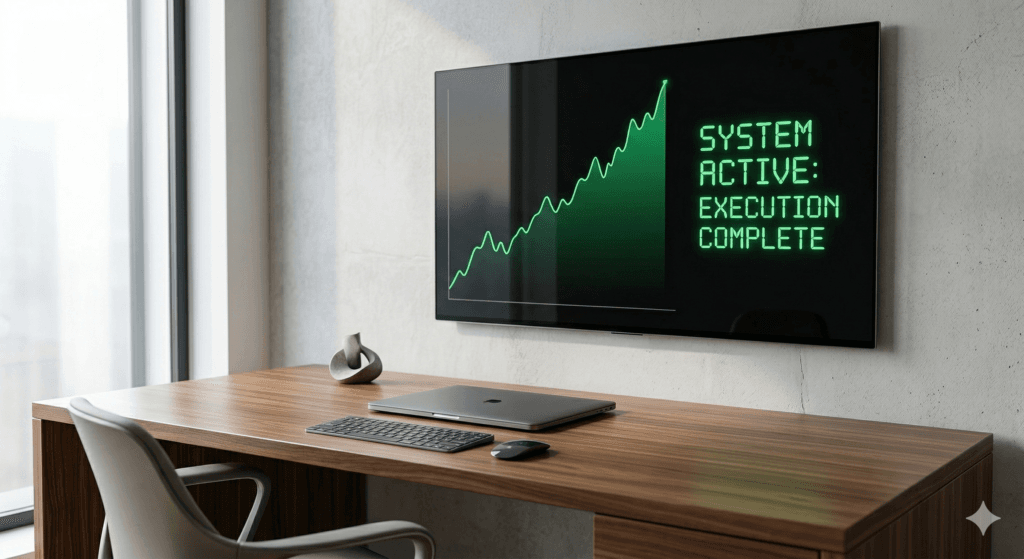
The journey to systematic trading requires a profound behavioral shift. You are no longer the “market captain” battling the waves in real-time. You are the engineer who designs the autopilot system.
This shift moves your cognitive load away from the moment of execution and toward high-value strategic tasks. Instead of agonizing over a single tick on a chart, your mental energy is spent on:
- Rigorous Backtesting: Statistically proving your strategy has an “edge” across decades of historical data, eliminating the need to “guess” if your approach works.
- Robust Development: Formalizing vague ideas into explicit, coded rules that a computer can execute flawlessly—revealing any ambiguities in your thinking.
- ** Flawless Monitoring:** Ensuring the system is running correctly, managing technology risk rather than emotional risk.
This is not “lazy” trading. It is efficient trading. It is recognizing that your unique human strength lies in pattern recognition and strategic design, not in competing with algorithms on execution speed while depleted.
Embracing Objective Observation
Surrendering to a systematic model is not an admission of weakness; it is a declaration of emotional freedom. It allows you to protect your portfolio not just from market volatility, but from the inevitable cognitive collapse that comes from manual trading.
When your system is active, you are no longer the participant whose identity is tied to the win/loss status of the current trade. You become a calm, objective observer of a mathematical process. This is the ultimate goal of trading psychology: flawless execution of a tested plan, without the pain of decision fatigue. Stop making trades and start designing wealth. Embrace the freedom of “No.”
Leave a Reply