
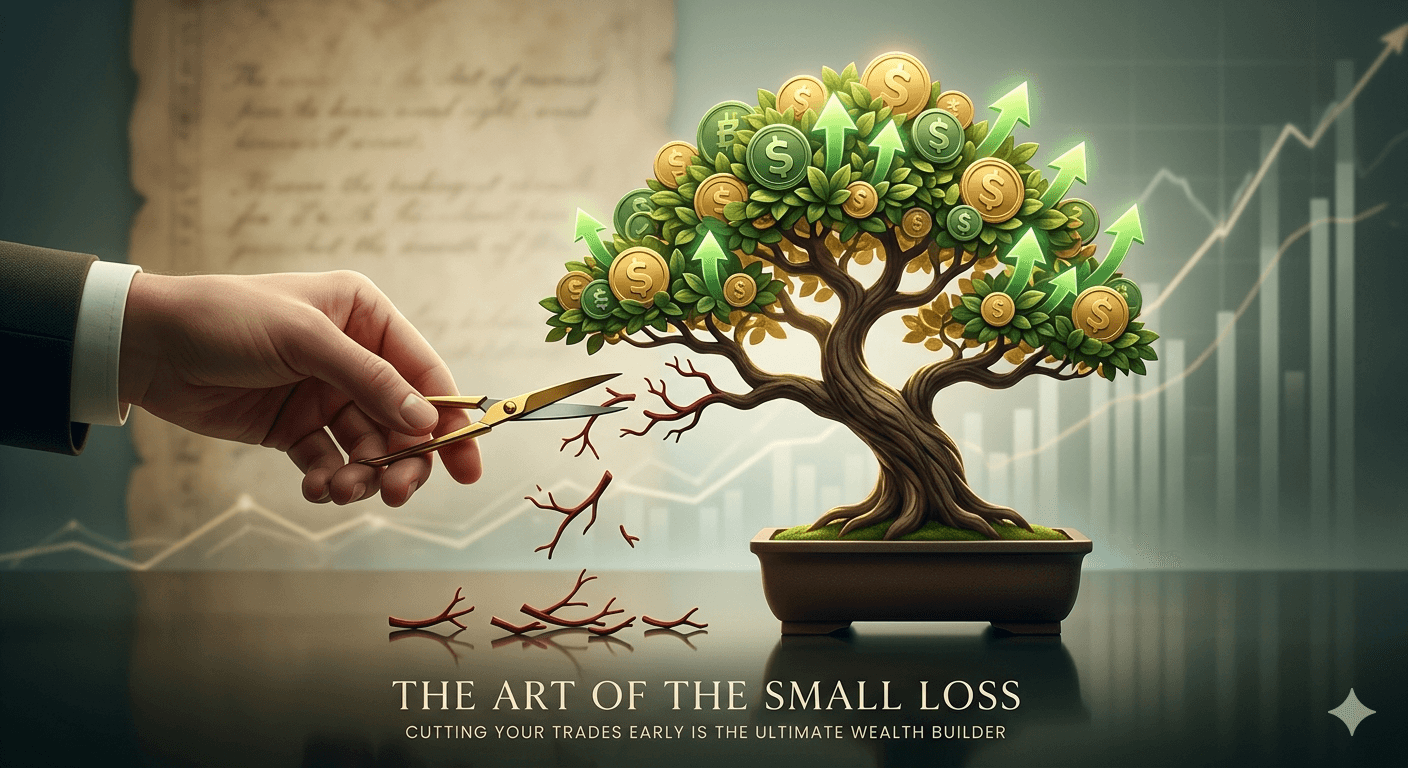
Let’s be honest: nobody likes being wrong, and absolutely nobody likes losing money. Our brains are hardwired to view a loss as a failure, a threat, or a blow to our ego. In everyday life, perseverance and “sticking it out” are virtues. But in the financial markets? That exact mindset can destroy your portfolio.
Traditional investing often preaches holding on for the long haul, weathering the storm, and waiting for a losing position to “bounce back.” But there is a completely different, counterintuitive approach that powers some of the most successful trend-following strategies in the world: embracing the small loss.
Here is why aggressively cutting your trades early isn’t a sign of defeat—it’s actually the ultimate wealth-building tool.
The Psychology of the Sunk Cost Fallacy
When a trade goes south, human nature kicks in. We tell ourselves stories to avoid the pain of realizing a loss:
- “It’s just a temporary dip.”
- “The fundamentals are still good; the market is just wrong right now.”
- “If I sell now, I lock in the loss. I’ll just wait until I break even.”
This is the sunk cost fallacy in action. You are letting your past investment of money and emotion dictate your future actions, rather than looking at the cold, hard reality of the price action. In trend following, the only truth is the price. If the trend has broken, the narrative doesn’t matter. By holding onto a losing position in the name of hope, you are exposing yourself to catastrophic risk.
The Brutal Math of Drawdowns
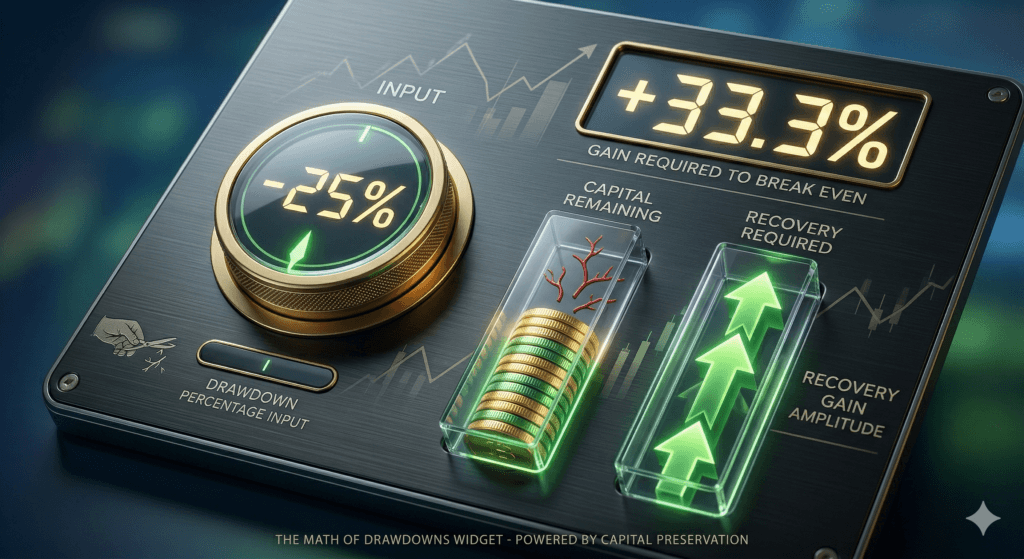
To understand why cutting losses early is mathematically vital, you have to look at the mechanics of drawdowns. Losing money works against you geometrically, not linearly.
When your portfolio takes a hit, you need a disproportionately larger gain just to get back to where you started.
| Portfolio Loss | Gain Required to Break Even | The Reality Check |
| 10% | 11% | Very manageable. A standard market correction. |
| 20% | 25% | Tough, but recoverable with time. |
| 50% | 100% | Devastating. You now have to double your money just to get back to zero. |
| 75% | 300% | Game over for most investors. |
The Trend Follower’s Mantra: A large loss is just a small loss that you refused to take.
By ruthlessly cutting a trade when it’s down 5% to 10%, you protect your capital base. You live to trade another day.
Reframing the “Loss” as a Business Expense
Trend followers don’t have crystal balls. In fact, many successful trend-following systems actually have a win rate of less than 50%. They are wrong more often than they are right. So, how do they make money?
Asymmetric returns.
Trend following relies on the reality that markets occasionally experience massive, structural moves. The strategy is designed to catch those massive waves while taking tiny paper cuts the rest of the time.
If you view trading as a business, your small losses are simply your operating expenses. They are the cost of doing business, the insurance premiums you pay to find the one trade that trends upward for 200%.
- The Losers: Down 2%, down 5%, down 4%. Cut, cut, cut.
- The Winners: Up 40%, up 80%, up 150%. Let them run.
When your winners are significantly larger than your losers, you don’t need to be right very often to build serious wealth.
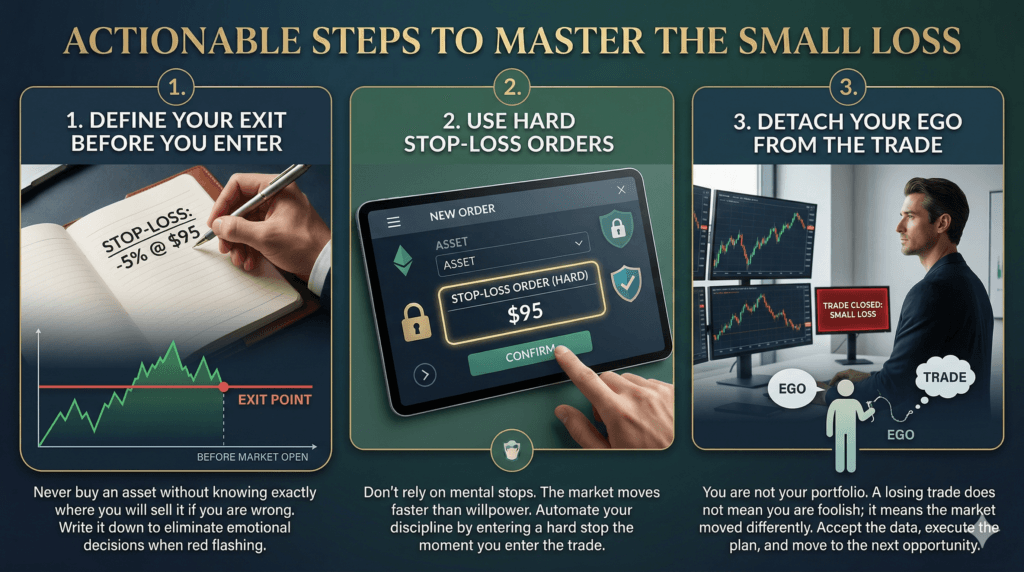
Actionable Steps to Master the Small Loss
Mastering this art is simple in theory but incredibly difficult in practice because it requires overriding your ego. Here is how you can start implementing this mindset today:
- Define Your Exit Before You Enter: Never buy an asset without knowing exactly where you will sell it if you are wrong. Write it down. This removes the emotional decision-making when the market is open and flashing red.
- Use Hard Stop-Loss Orders: Don’t rely on mental stops. The market can move faster than your willpower. Automate your discipline by entering a stop-loss order the moment you enter the trade.
- Detach Your Ego from the Trade: You are not your portfolio. A losing trade does not mean you are foolish; it just means the market moved in a different direction. Accept the data, execute the plan, and move on to the next opportunity.
The Bottom Line
The financial markets are unpredictable. You cannot control what a stock, a commodity, or the broader economy will do tomorrow. The only thing you have absolute control over is how much money you are willing to lose on any given idea.
By mastering the art of the small loss, you eliminate the possibility of a catastrophic wipeout. You clear the psychological baggage of holding onto dead weight. And, most importantly, you preserve your capital so that when the next massive trend finally arrives, you are fully funded and ready to ride it.
Leave a Reply