
To understand how a systematic trader interacts with market swings, we must first understand the foundational objective of trend following: identifying and riding the path of least resistance. Markets are essentially massive discounting mechanisms, constantly absorbing and pricing in millions of data points, from shifting macroeconomic growth and inflation dynamics to hyper-specific semiconductor supply chain bottlenecks. Discretionary traders exhaust themselves trying to decipher exactly which data point is moving the market on any given day. They try to predict whether we are entering a Goldilocks scenario or a period of stagflation, placing their capital on the line based on a subjective forecast.
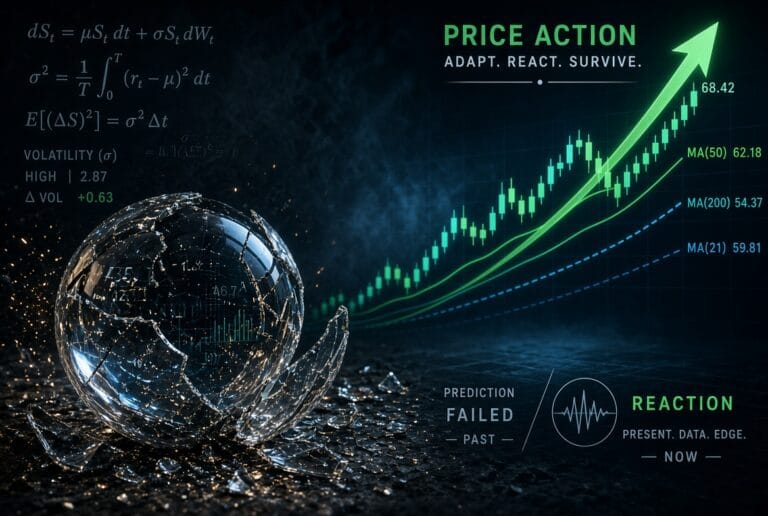
Systematic trend followers abandon this futile guessing game entirely. They recognize that regardless of the underlying fundamental catalyst, the market’s reaction will ultimately manifest in price action. The path of least resistance is mathematically defined by moving averages, breakout channels, and momentum oscillators. A systematic model does not care why a particular asset class is moving; it only cares that the quantifiable metrics dictate a trend is in motion. By keeping the model simple—adhering to a strict “Keep It Simple, Stupid” (KISS) philosophy when it comes to signal generation—the trader avoids the paralysis of over-analysis. The system merely waits for the math to confirm that the path of least resistance has been established, and then mechanically deploys capital in that direction. This objective stance completely isolates the trader from the frantic noise of financial television and the subjective panic that usually accompanies shifting market regimes.
Capitalizing on Inefficiency: Why Institutional Flows Create Trends
The reason these paths of least resistance often turn into massive, multi-month trends lies in the structural inefficiencies of institutional capital allocation. Trends do not exist because retail traders are clicking buttons on their brokerage apps; trends exist because massive pools of global liquidity are forced to reposition when the macro weather changes.
Consider a scenario where the macroeconomic regime transitions heavily into a deflationary quadrant, forcing massive sovereign wealth funds and pension managers to aggressively reallocate away from cyclical equities and into the safety of the US Yield Curve and Treasury Inflation-Protected Securities (TIPS). A multi-billion-dollar fund cannot simply dump its equity holdings and buy bonds at the market open. Doing so would cause catastrophic slippage, effectively crashing the market against their own orders.
Instead, these institutions utilize adaptive execution algorithms to scale in and out of positions over weeks and months. This slow, deliberate repositioning of capital creates a persistent drift in the asset’s price. Systematic trend following is explicitly designed to capitalize on this exact inefficiency. By utilizing adaptive trend signals that measure the rate of change and volume flows, the systematic trader aligns their portfolio with the lumbering movements of institutional giants. As long as the big money is forced to continuously buy or sell to reach their target allocations, the trend will persist, and the systematic model will remain engaged, happily riding the momentum generated by the market’s heaviest participants.
The Sunk Cost Fallacy: Why We Marry Our Losing Positions
Navigating volatility requires a disciplined psychological framework, primarily because human beings are biologically wired to handle financial loss poorly. One of the most destructive cognitive biases in trading is the sunk cost fallacy. This is the psychological trap where a trader refuses to abandon a losing position simply because they have already invested significant time, capital, and emotional energy into the trade.
In a discretionary trading environment, a sudden spike in volatility against a trader’s position often triggers a dangerous defense mechanism. Instead of objectively evaluating the new price action, the discretionary trader rationalizes the loss. They convince themselves that the market is wrong, that the volatility is just a temporary “shakeout,” and they may even average down, throwing good money after bad. They marry the losing position, hoping that a miraculous reversal will eventually validate their original thesis and make them whole.
Systematic trend following ruthlessly eliminates the sunk cost fallacy. An algorithmic model does not possess an ego, nor does it feel the psychological sting of being wrong. When volatility expands and price action breaches the mathematical threshold of a hard stop, the system terminates the trade instantly. There is no hesitation, no rationalization, and no emotional attachment to the asset. By cutting the loss mechanically, the systematic trader preserves their capital and their mental bandwidth, freeing up resources to deploy on the next high-probability setup. In the realm of trend following, a small, controlled loss is not a failure; it is simply the natural cost of doing business in a probabilistic environment.
Mechanical Execution vs. Discretionary Hesitation
The difference between surviving market volatility and being destroyed by it often comes down to the speed and decisiveness of execution. When a market abruptly transitions from a calm, low-volatility grind into a chaotic, high-volatility expansion, discretionary traders often freeze. This hesitation is born from a lack of clarity. Because their trading rules are subjective and loosely defined, they don’t know exactly what to do when the environment changes rapidly. Should they widen their stops? Should they take partial profits? Should they hedge? While they debate these questions, the market continues to move, often turning a manageable drawdown into a catastrophic loss.
Mechanical execution eliminates this hesitation entirely. A robust systematic model is built on absolute, unambiguous rules that dictate action across specific time durations—clearly separating the rules for a short-term Trade, an intermediate Trend, and a long-term Tail allocation. Before a position is even initiated, the model has already calculated exactly where the invalidation point lies and exactly how to manage the trade as it progresses.
When the volatility arrives, the systematic trader does not need to consult the news, read macro research reports, or trust their gut. They simply execute the mandate of the code. This mechanical adherence to the system provides an immense psychological relief. It outsources the heavy lifting of real-time decision making to a backtested algorithm, allowing the trader to operate with cold, calculated precision even when the rest of the market is descending into panic.
Volatility-Adjusted Sizing: Managing Risk Dynamically
The most sophisticated aspect of modern systematic trend following is how it actually uses volatility to calculate risk. Amateur traders often trade a fixed number of shares or a fixed dollar amount for every setup, regardless of the underlying market environment. This is a mathematically flawed approach because it ignores the actual risk profile of the asset at that specific moment in time.
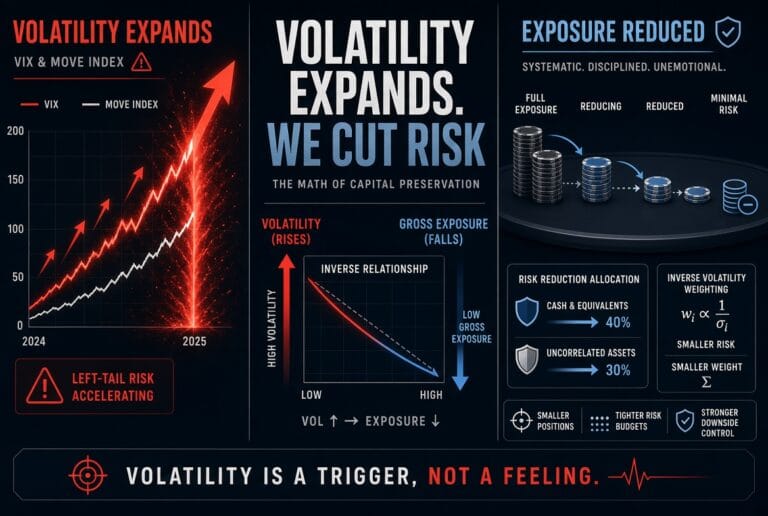
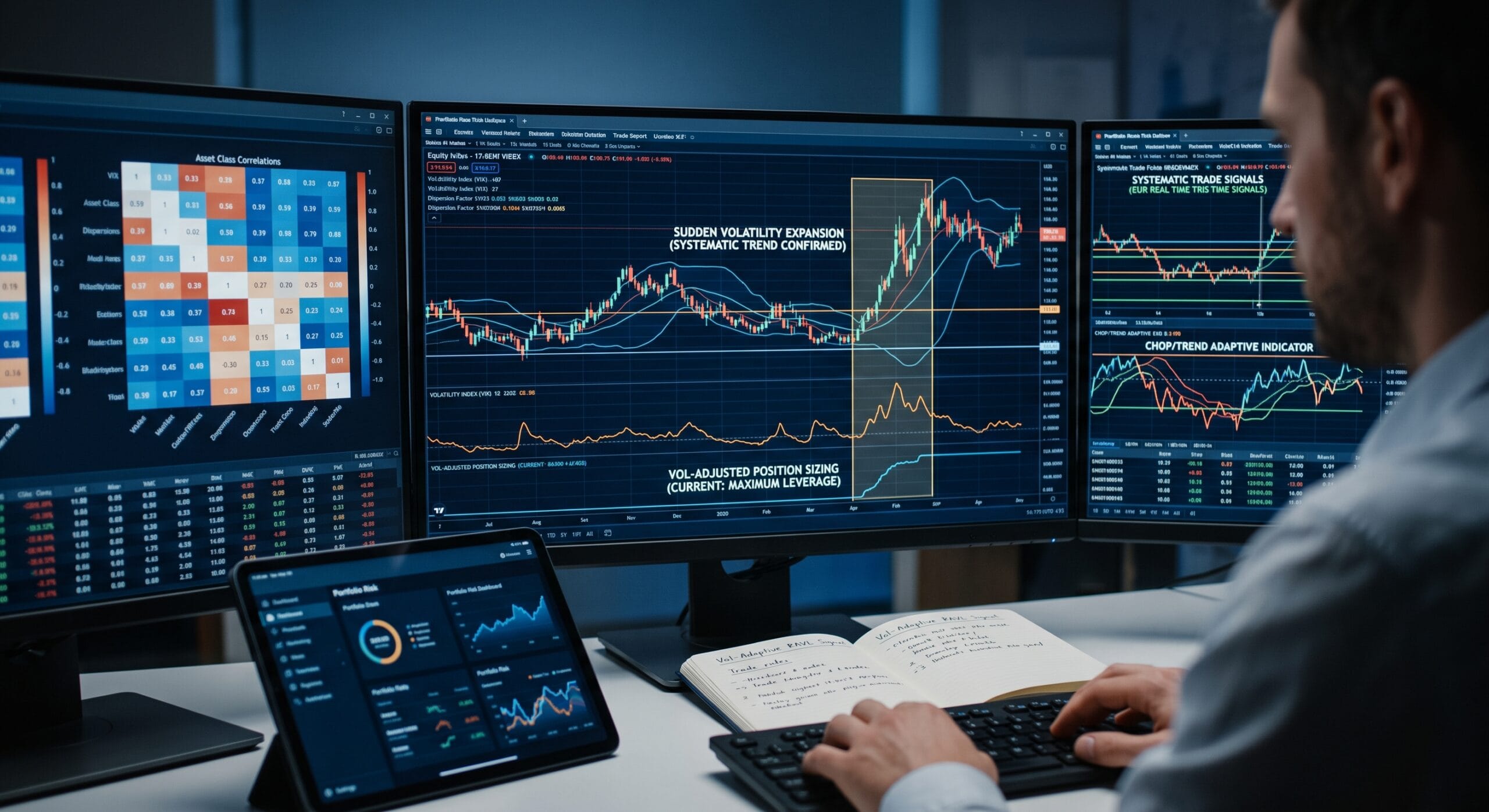
Professional systematic models utilize dynamic, volatility-adjusted position sizing to equalize risk across the entire portfolio. By constantly monitoring real-time volatility metrics—such as the VIX for broader equity market stress or the MOVE Index for fixed-income volatility—the system automatically scales its exposure. If a market is exhibiting incredibly low volatility, characterized by tight daily ranges and smooth price action, the model will calculate that it can safely hold a larger position size without risking a catastrophic gap against the portfolio.
Conversely, when the VIX spikes and the market regime shifts into a highly volatile, erratic state, the system’s mathematical formulas automatically shrink the position size. By risking less capital per trade during periods of high turbulence, the model ensures that the portfolio’s overall drawdown remains rigidly contained, even if the frequency of stop-outs increases. This dynamic calibration is the ultimate risk management shield. It prevents the trader from being over-leveraged during market crashes and ensures that when the massive, low-volatility trends eventually return, the portfolio is fully capitalized and ready to compound aggressive returns.