
Wall Street has successfully trained an entire generation of investors to view volatility as a storm you simply have to endure. When equity volatility spikes, or when the MOVE Index surges indicating structural instability in the bond market, the standard wealth management advice is entirely passive. They tell you to “hang in there,” “stay the course,” and remember your long-term goals.
For an investor with significant capital—someone who has spent decades building their net worth—that is not a strategy. That is pure capitulation to hope. In quantitative trend following, volatility is not a feeling, a headline, or something to be feared. It is a strict mathematical trigger.
Volatility as a Mathematical Trigger
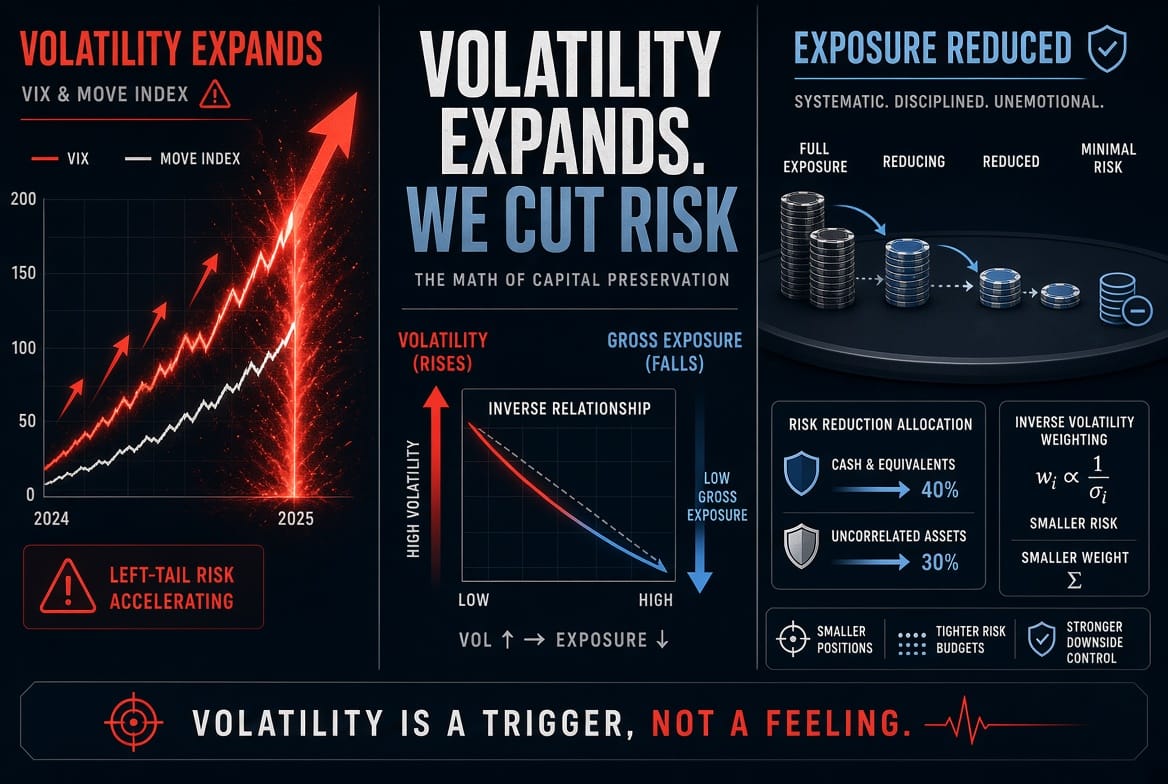
Volatility is the most accurate real-time indicator of institutional liquidity and risk appetite. When volatility expands across our immediate Trade durations and longer-term Trend durations, the mathematical probability of severe, left-tail drawdowns increases exponentially. Volatility clusters; large moves breed larger moves. The math dictates a simple, unemotional, and automatic response: we cut gross exposure.
Traditional portfolios are structurally blind to volatility regimes. A standard 60/40 investor holds the exact same position sizes whether the VIX is sleeping at 12 or screaming at 35. This is a catastrophic flaw in portfolio construction. As market variance widens, holding static position sizes guarantees that your portfolio will suffer outsized damage during market shocks.
Solving the Static Portfolio Problem
Systematic risk management solves this by inversely weighting position sizes to volatility. As the MOVE Index or the VIX accelerates, our algorithms mechanically reduce exposure. We do not sit around conference tables debating if a geopolitical event will resolve peacefully, or if the Federal Reserve will step in to save the market. The expanding volatility signal is all the evidence we need to take chips off the table.
We do not attempt to predict the exact day the bottom will fall out, because prediction is a fool’s errand. Instead, we let the volatility signals dictate our capital deployment. When the severe left-tail event inevitably hits, our exposure has already been systematically reduced. We are out of the way, preserving our capital base in cash or uncorrelated assets, patiently waiting to deploy it aggressively when volatility eventually compresses and a new, clean trend emerges.