

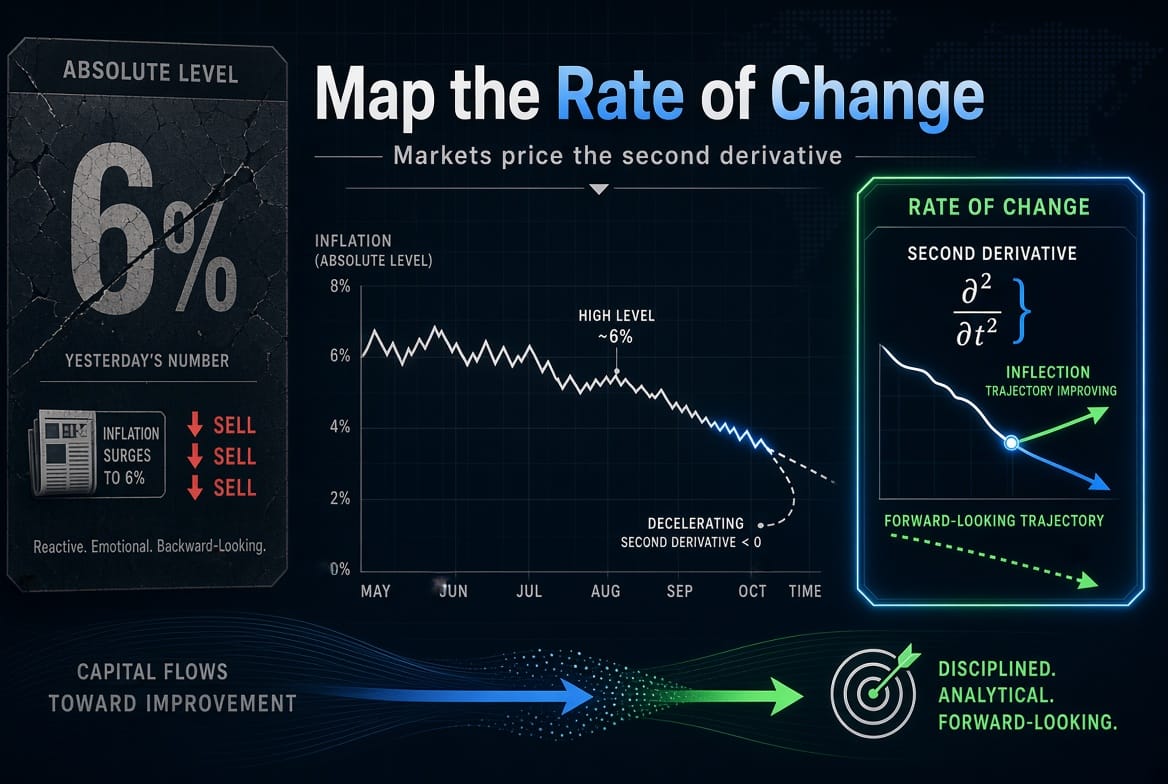
One of the most persistent traps in modern investing is the obsession with absolute numbers. Turn on any financial television network on the morning of a major data release, and you will see a panel of pundits arguing about the absolute level of the data. They look at a Consumer Price Index (CPI) print or Personal Consumption Expenditures (PCE) and argue about whether the number itself is “good” or “bad.”
Professionals do not care about the absolute number. We care about the second derivative: the rate of change.
Pricing in the Future at the Margins
Financial markets are forward-looking discounting mechanisms. They price in the future at the margins. If inflation is sitting at an uncomfortable 4%, the market does not trade based on the absolute value of 4%. It trades on whether the underlying, high-frequency data is trending toward 3.5% or accelerating toward 4.5%.
Consider an environment where inflation is objectively high, say 6%, but the month-over-month rate of change has flipped negative. The amateur investor looks at the 6% and panics, selling risk assets because “inflation is out of control.” The systematic investor looks at the negative rate of change, recognizes that disinflation is mechanically flowing through the system, and buys the exact assets the amateur is dumping.
By the time an absolute economic number looks definitively terrible or undeniably fantastic on television, the damage to the latecomer’s portfolio has already been done, and the trend is nearing exhaustion.
Front-Running the Narrative
This concept applies to every fundamental input: Nominal GDP, corporate earnings, and labor market metrics. By mathematically mapping the rate of change across these indicators, systematic models catch the inflection points early. We measure whether the data is getting better or getting worse on a trending basis.
When you adopt a rate-of-change framework, you stop reacting to yesterday’s news and start front-running tomorrow’s economic reality. You strip away the subjective arguments about valuation and focus purely on momentum and trajectory. The trend follower’s edge comes from positioning for the shift in the data before the broader crowd even realizes the narrative has changed. It requires discipline, strict quantitative inputs, and the willingness to ignore the noise of absolute levels in favor of the silent, undeniable power of the second derivative.



Discussion
Thoughtful questions and respectful disagreement are welcome.